FRCR Part 1 Physics · Ultrasound · Bioeffects and safety
Ultrasound Bioeffects and Safety: FRCR Part 1 High-Yield Review
Published by FRCR AI · AI-assisted educational content
Created and overseen by Dr. Tan Min On, Radiologist — MedNex Pte. Ltd.
Published · Updated
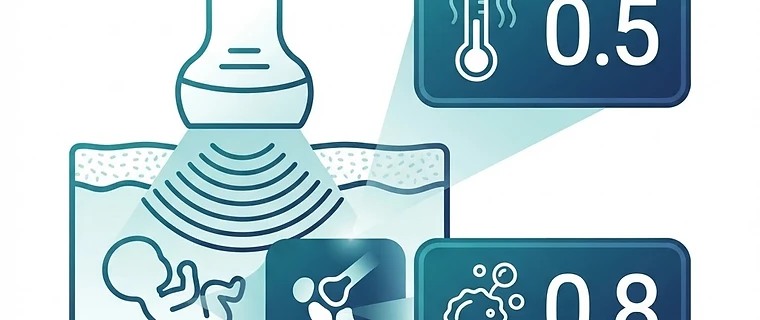
Ultrasound Bioeffects and Safety: High-Yield FRCR Physics
Understanding the potential bioeffects of ultrasound is critical for safe practice and remains a core component of the FRCR Part 1 Physics exam. Modern safety standards shift the responsibility to the clinician to interpret real-time safety indices under the overarching ALARA principle—As Low As Reasonably Achievable.
1. The Output Display Standard (ODS)
Modern ultrasound systems display the Thermal Index (TI) and Mechanical Index (MI) to provide real-time guidance on potential bioeffects. These indices are mandatory on all diagnostic systems to assist the user in managing risk during an examination. The TI estimates the potential for tissue temperature rise, while the MI serves as a proxy for non-thermal effects, specifically cavitation—the interaction of the acoustic field with gas-filled bodies. Exam tip: Always correlate the MI with the potential for cavitation and the TI with the potential for tissue heating.
2. Thermal Index (TI) Categorization
To enhance accuracy, the TI is sub-classified based on the specific anatomical targets and tissue compositions.
- TIS (Soft Tissue Thermal Index): Used when the focus is at or near the surface or in soft tissue.
- TIB (Bone Thermal Index): Used when bone is at or near the focus, which is particularly critical for second and third-trimester fetal scans as bone absorbs significantly more ultrasound energy than soft tissue.
- TIC (Cranial Bone Thermal Index): Used when the transducer is near or over the cranium (e.g., transcranial imaging). Exam tip: Know that TIB is the relevant index for fetal bone near the transducer focus, as this often yields higher values than TIS.
3. Non-Thermal Effects: Cavitation
The Mechanical Index is directly related to the peak rarefactional pressure and inversely related to the square root of the frequency (MI ≈ peak rarefactional pressure / √frequency). Cavitation is categorized as 'stable' (bubbles oscillate without collapse) or 'inertial/transient' (bubbles collapse violently, producing localized high temperatures and shock waves). Inertial cavitation presents the most significant risk for structural tissue damage. Exam tip: Remember the relationship: MI increases with higher pressure amplitudes and decreases with higher frequencies.
4. Risk Mitigation and Clinical Practice
The ALARA principle dictates that output should be minimized, and scan duration kept as short as possible.
- Spectral Doppler: This mode remains the highest-risk diagnostic tool for thermal bioeffects due to its high duty cycle and the tendency to focus the beam on a small, stationary volume.
- 3D/4D Imaging: Contrary to common misconceptions, 3D/4D imaging is not inherently more dangerous than 2D imaging, provided that the dwell time is kept within safe limits and the system's index display is monitored.
- Modern Guidelines: Diagnostic ultrasound remains exceptionally safe when performed appropriately. Recent systematic reviews (2024) have explicitly confirmed that there is no causal link between prenatal ultrasound and Autism Spectrum Disorder (ASD).
| Index | Purpose | Primary Bioeffect |
|---|---|---|
| TI | Thermal Index | Tissue heating |
| MI | Mechanical Index | Cavitation |
5. Emerging Applications and Safety
Clinicians must remain updated on emerging applications such as transcranial focused ultrasound and therapeutic neuromodulation. These techniques operate under strictly controlled safety protocols that differ from standard diagnostic imaging. Standardized reporting guidelines have been established to ensure that energy deposition remains within safe limits for delicate neural tissue. It is vital for exam candidates to distinguish between diagnostic diagnostic ultrasound, which is strictly governed by the ODS, and therapeutic ultrasound, which requires higher intensities for biological effect.
Key Takeaway: Ultrasound safety is governed by the user-monitored Thermal (TI) and Mechanical (MI) indices. By applying the ALARA principle and prioritizing shorter examination times—particularly during Spectral Doppler—clinicians ensure diagnostic benefit significantly outweighs potential bioeffects. Always rely on current indices rather than deprecated fixed application-specific intensity limits.
Topics: ultrasound · physics · safety · frcr · bioeffects