FRCR Part 1 Physics · Nuclear Medicine · Radionuclide production
Radionuclide Production for Nuclear Medicine
Published by FRCR AI · AI-assisted educational content
Created and overseen by Dr. Tan Min On, Radiologist — MedNex Pte. Ltd.
Published · Updated
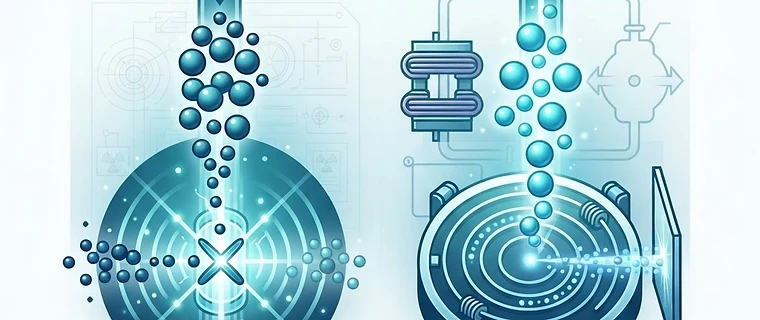
Radionuclide Production for Nuclear Medicine
Understanding the physical principles of radionuclide generation is essential for the FRCR Part 1 exam, as these methods determine the availability, purity, and clinical utility of radiopharmaceuticals used in radionuclide imaging. This overview covers the primary production pathways utilised in modern nuclear medicine: reactor-based production, cyclotron-based production, and generator systems.
1. Reactor-Based Production
Nuclear reactors produce radionuclides primarily through neutron bombardment of stable target material within the reactor core. When a stable nucleus captures a neutron (an (n, γ) reaction), it becomes a heavier isotope of the same element that is typically neutron-rich and unstable, decaying by beta-minus emission. Because the product is the same element as the target, these (n, γ)-produced radionuclides generally have relatively low specific activity, as the radioactive atoms are mixed with a large excess of non-radioactive target atoms (i.e., they are not carrier-free). Alternatively, nuclear fission of heavy target nuclei such as uranium-235 generates a spectrum of fission products, including molybdenum-99; because the daughter element differs from the parent, fission-derived radionuclides can be chemically separated to achieve much higher specific activity.
Exam tip: Reactor-produced isotopes are generally neutron-rich and decay by beta-minus emission.
2. Cyclotron-Based Production
Cyclotrons accelerate charged particles — protons, deuterons, or alpha particles — to high energies using alternating electromagnetic fields, then direct them at a target material. The resulting nuclear reactions typically produce neutron-deficient radionuclides, which decay by positron emission (e.g., fluorine-18) or electron capture. Because cyclotron targets undergo a nuclear transformation to a different element, the products can usually be obtained carrier-free, giving high specific activity. Cyclotrons are the principal source of short-lived positron-emitting radionuclides used in PET imaging.
Exam tip: Cyclotron-produced isotopes are characteristically neutron-deficient and decay by positron emission or electron capture.
3. Radionuclide Generators
Generators provide a practical means of supplying short-lived daughter radionuclides on-site from a longer-lived parent, without the need for an on-site reactor or cyclotron — commonly described as "milking" the generator. The most widely used example is the molybdenum-99/technetium-99m generator, in which the parent (molybdenum-99) decays to the clinically useful daughter (technetium-99m); the parent's longer half-life allows repeated elution of fresh daughter activity over several days. Other generator systems, such as germanium-68/gallium-68, operate on the same principle for PET radiopharmaceuticals. Quality control of generator eluate — including testing for radionuclidic purity (parent breakthrough), radiochemical purity, and sterility — is essential before clinical use.
Exam tip: In any generator system, the parent must have a significantly longer half-life than the daughter to permit repeated elution.
4. Comparison of Production Modalities
Choosing between production methods depends on the required decay mode, half-life, specific activity, and intended clinical application.
| Feature | Reactor-Produced | Cyclotron-Produced |
|---|---|---|
| Primary process | Neutron bombardment / fission | Charged particle bombardment |
| Isotope type | Neutron-rich | Neutron-deficient |
| Decay mode | Beta-minus | Positron emission / electron capture |
| Specific activity | Often lower (carrier-added) for (n, γ) products | Typically high (carrier-free) |
| Example | Molybdenum-99, Iodine-131 | Fluorine-18, Gallium-68 |
Exam tip: Associate reactor production with neutron-rich isotopes and cyclotron production with neutron-deficient isotopes.
Key Takeaway: Radionuclide production for nuclear medicine relies on two complementary methods — reactors (neutron bombardment/fission, yielding neutron-rich, beta-minus-emitting products) and cyclotrons (charged particle bombardment, yielding neutron-deficient, positron- or electron-capture-emitting products) — with generator systems bridging the gap by supplying short-lived daughter isotopes to clinical departments without requiring on-site reactor or cyclotron facilities.
References and further reading
Topics: nuclear medicine · radionuclide production · physics · frcr · cyclotron · reactor