FRCR Part 2A · Musculoskeletal · Soft tissue masses
FRCR Musculoskeletal: Soft Tissue Masses
Published by FRCR AI · AI-assisted educational content
Created and overseen by Dr. Tan Min On, Radiologist — MedNex Pte. Ltd.
Published · Updated
Essential Concepts in Soft Tissue Masses: A High-Yield FRCR Guide
Radiological evaluation of soft tissue masses requires a structured approach aligning with the 2020 WHO classification and current AJCC 8th edition staging to ensure diagnostic accuracy and prognostic relevance for the FRCR exam. Mastery of these concepts is essential for differentiating benign from malignant processes and staging sarcomas effectively.
1. The ALT vs. WDLPS Distinction
Terminology is strictly dictated by anatomical location due to varying risks of recurrence and biological potential. Atypical Lipomatous Tumour (ALT) is the designated term for lesions in the extremity and trunk where surgical excision is generally curative. Conversely, the term Well-Differentiated Liposarcoma (WDLPS) is used for histologically identical lesions occurring in the retroperitoneum, mediastinum, or spermatic cord, owing to their increased risk of recurrence and dedifferentiation. Both entities are characterized by MDM2 and CDK4 protein overexpression, detectable via immunohistochemistry or genetic amplification. Exam tip: Always check the location in the clinical vignette. If you see a fatty mass in the retroperitoneum, it must be referred to as WDLPS, not ALT.
2. AJCC 8th Edition T-Staging Updates
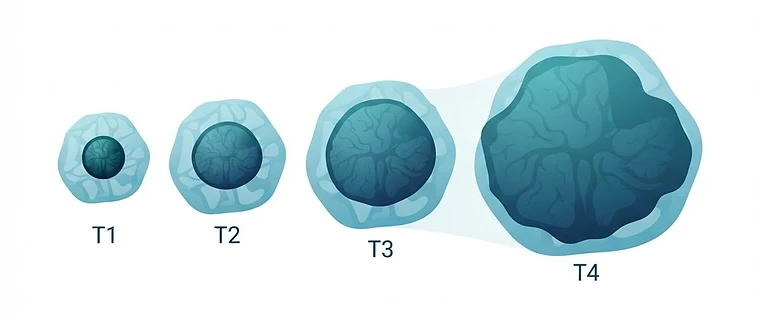
Staging for extremity and trunk sarcomas has transitioned to a four-tier T-category system. This system prioritizes tumor size as a prognostic indicator and has officially removed "depth" (superficial vs. deep) as a staging criterion. The categories are:
- T1: ≤5 cm
- T2: >5 to 10 cm
- T3: >10 to 15 cm
- T4: >15 cm Exam tip: The 5, 10, and 15 cm cutoffs are high-yield for rapid-fire MCQs. Do not be distracted by references to tumor depth, which are no longer part of the T-stage calculation.
3. Lymph Node Metastasis Patterns: The SCARE Acronym
While the majority of soft tissue sarcomas metastasize hematogenously to the lungs, a select group exhibits a notable propensity for regional lymph node involvement. Candidates should memorize the acronym SCARE:
- S: Synovial sarcoma
- C: Clear cell sarcoma
- A: Angiosarcoma
- R: Rhabdomyosarcoma
- E: Epithelioid sarcoma Exam tip: Identifying these specific histologies is crucial, as they may necessitate different imaging protocols, such as dedicated nodal basin assessment.
4. Updating Obsolete Terminology
Maintaining current nomenclature is critical for FRCR success. The term Malignant Fibrous Histiocytoma (MFH) is now obsolete and should never be used. It has been replaced by more specific entities including Undifferentiated Pleomorphic Sarcoma (UPS), myxofibrosarcoma, or dedifferentiated liposarcoma. Similarly, the term hemangiopericytoma is deprecated and is now incorporated into the solitary fibrous tumor spectrum, which utilizes a risk-stratification model based on mitotic index, tumor size, and the presence of necrosis. Exam tip: If you encounter MFH in legacy practice materials, recognize it as an outdated placeholder for UPS and prioritize the use of contemporary WHO terminology.
5. Summary of Key Molecular and Clinical Distinctions
| Entity | Key Molecular/Clinical Feature | Metastatic Pattern |
|---|---|---|
| ALT/WDLPS | MDM2/CDK4 Amplification | Low risk (unless dedifferentiated) |
| Solitary Fibrous Tumor | Risk-stratified by mitosis/size | Potentially metastatic |
| Synovial Sarcoma | Often periarticular/calcified | Pulmonary + Lymph Node |
| UPS | Diagnosis of exclusion (replaces MFH) | Pulmonary |
6. Emerging Concepts and WHO Updates
- Tenosynovial Giant Cell Tumour (TGCT): The current terminology replaces older terms; localized type covers what was formerly giant cell tumour of the tendon sheath, while diffuse type replaces pigmented villonodular synovitis (PVNS).
- Round Cell Sarcomas: The WHO now recognizes "undifferentiated small round cell sarcomas" as a distinct category, differentiating them from Ewing sarcoma via specific genetic fusions (e.g., CIC-rearranged or BCOR-rearranged).
- Targeted Therapy: Recognition of NTRK-rearranged spindle cell neoplasms is increasingly important due to the availability of targeted TRK-inhibitor therapy.
Key Takeaway: Success in the FRCR musculoskeletal module requires strict adherence to the 2020 WHO classification. Focus on anatomical naming, the four-tier AJCC T-staging, and the SCARE group for lymph node metastases.
Topics: frcr · musculoskeletal · radiology · sarcoma · who classification